
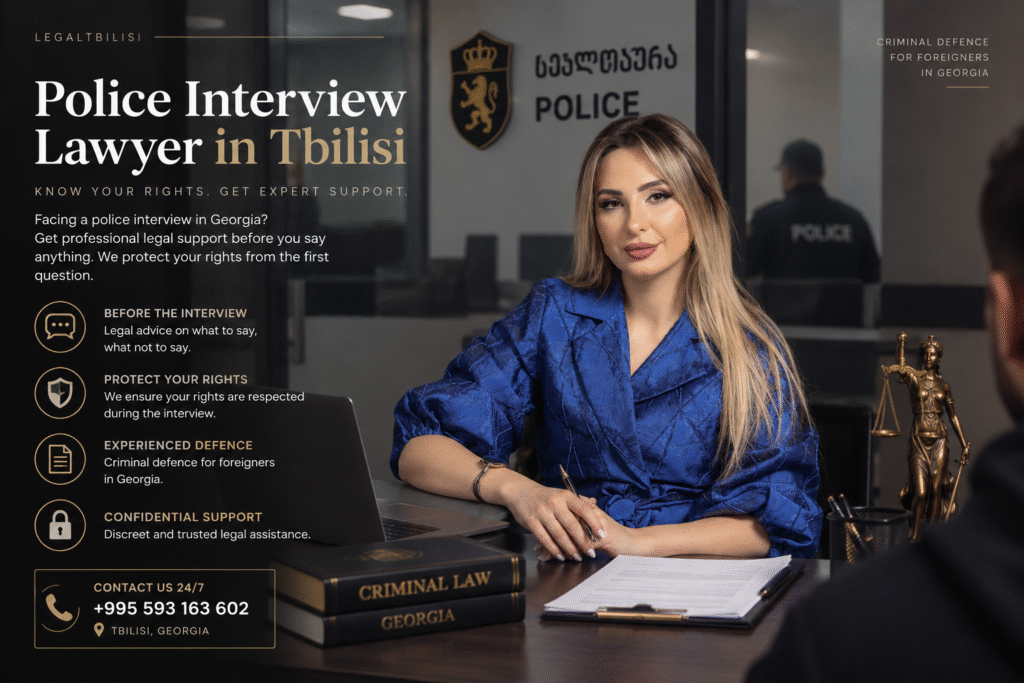
Police Interview Lawyer in Tbilisi — Legal Advice Before Police Questioning in Georgia
Being asked to attend a police interview in Georgia can be more serious than it initially appears. You may be told that investigators simply want to “ask a few questions,” clarify certain circumstances, or obtain information about another person. You need Police Interview Lawyer in Tbilisi.
However, what you say during police questioning may influence the direction of a criminal investigation and, depending on your status and the circumstances, may later become important evidence.
If you have been contacted by the police, summoned for questioning, or asked to provide a statement in Tbilisi or elsewhere in Georgia, obtaining legal advice before the interview takes place can be critical.

Tamta Zarnadze provides criminal defence and legal representation during police interviews and criminal investigations in Georgia, including assistance to foreign nationals who may be unfamiliar with Georgian criminal procedure.
Tamta Zarnadze Contacts:
📧 tamta.zarnadze@gmail.com
📞 Phone: +995 593 163 602
🌐 Languages: Georgian · English · Russian
Location: Tbilisi, Chavchavadze Avenue, 75
Contacted by the Police in Georgia? Speak to a Lawyer Before the Interview
Do not assume that an invitation to speak with investigators is merely a routine formality.
Before attending, it is important to understand:
- why the police want to question you;
- what your procedural status is;
- whether you are being treated as a witness or a potential suspect;
- what rights you have during questioning;
- whether you should provide a statement;
- whether a lawyer should attend with you.
The safest time to obtain legal advice is before answering substantive questions, not after an interview has already taken place.
Why Police Interviews Matter
Police interviews are an important part of criminal investigations.
Investigators may use questioning to:
- establish a timeline of events;
- identify inconsistencies between different accounts;
- obtain information about other individuals;
- clarify financial transactions;
- determine ownership or possession of property;
- establish relationships between suspects and witnesses;
- compare statements with digital or documentary evidence;
- assess whether further investigative measures are necessary.
A person may enter an interview believing that they are helping investigators and later discover that the investigation has begun focusing on their own conduct.
That is one reason why understanding your legal position before questioning is so important.
Are You a Witness, Suspect, or Potential Target?
One of the first questions a criminal defence lawyer should consider is why investigators want to speak with you and in what capacity.
Your legal position may not always be obvious from an informal telephone call or request to attend a police station.
You may initially be contacted because investigators believe you have information about another person. During the investigation, however, evidence or statements may cause the authorities to examine your own conduct more closely.
For this reason, you should not make assumptions about your position based solely on how an investigator describes the meeting.
If circumstances suggest that you may be under criminal investigation in Georgia, obtaining independent legal advice before providing a statement becomes particularly important.
Read More: under criminal investigation in Georgia
Should You Attend a Police Interview Without a Lawyer?
You should obtain legal advice before deciding how to approach police questioning.
A criminal defence lawyer can help determine:
- your procedural status;
- the potential risks associated with questioning;
- what information investigators may already possess;
- whether particular questions raise legal concerns;
- how to protect your rights during the interview.
The purpose of having a lawyer is not to obstruct an investigation. It is to ensure that you understand the process and do not unintentionally damage your legal position.
What Should You Do If Police Contact You?
If Georgian police or investigators contact you for questioning:
- Do not panic.
- Ask who is contacting you and from which authority.
- Ask why your attendance is requested.
- Record the investigator’s contact information.
- Do not attempt to explain the entire situation over the telephone.
- Do not delete messages, documents, files, or other potentially relevant information.
- Contact a criminal defence lawyer before substantive questioning takes place.
If you do not speak Georgian fluently, make sure you understand what is being asked of you and seek appropriate language assistance where necessary.
What You Should Not Do Before Police Questioning
People sometimes create additional problems for themselves before they even arrive at the police station.
Avoid:
- giving lengthy explanations over the telephone;
- guessing answers to questions;
- discussing your strategy with potential witnesses;
- coordinating stories with other people involved;
- deleting messages or electronic records;
- altering financial or corporate documents;
- posting details about the investigation on social media;
- signing documents you do not fully understand.
Attempts to “fix” the situation independently can create evidence that becomes more damaging than the original allegation.
Police Interviews in Financial Crime Investigations
Police questioning is particularly important in complex financial cases.
Investigators may ask about:
- bank transfers;
- source of funds;
- corporate structures;
- cryptocurrency transactions;
- accounting records;
- business relationships;
- international payments;
- beneficial ownership;
- tax declarations.
A seemingly simple explanation of a transaction can have consequences across a broader financial investigation.
If questioning relates to suspected money laundering, tax offences, cryptocurrency, fraud, or unexplained funds, legal preparation should take into account the entire financial context of the case.
Relevant Financial Crime Services
More services: financial crime investigations
More services: money laundering
More services: source of funds
More services: tax offences
More services: cryptocurrency investigations
Police Interviews in Drug Crime Investigations
Drug investigations may involve questioning about:
- possession;
- ownership of substances;
- communications with other individuals;
- travel history;
- airport incidents;
- pharmaceutical products;
- alleged distribution or smuggling.
Statements made early in a drug investigation may later be compared with laboratory evidence, electronic communications, surveillance information, or witness statements.
If the investigation follows an airport detention or drug-related arrest, immediate criminal defence representation is especially important.
Relevant Drug Crime Services
More services: drug crime investigations
More services: airport drug arrest
More services: smuggling
Police Interviews Following Assault or Domestic Violence Allegations
Police questioning frequently occurs after allegations involving:
- assault;
- bodily injury;
- domestic violence;
- threats;
- self-defence.
These cases can develop rapidly because investigators may be working with conflicting statements from the people involved.
A person who believes they acted in self-defence, for example, should be particularly careful about giving an improvised explanation without first understanding the legal significance of the circumstances.
Relevant Violent Crime Services
More services: assault allegations
More services: false domestic violence allegations
More services: self-defence
What If Police Want to Search Your Phone or Property?
Police questioning may be accompanied by other investigative measures.
Investigators may seek access to:
- mobile phones;
- computers;
- messages;
- financial records;
- vehicles;
- homes;
- offices.
If a police interview is connected with a search or seizure, the legality and scope of those investigative actions may become important to the defence.
Read More: search and seizure
What If You Are Arrested During an Investigation?
A request for questioning and an arrest are different situations, but investigations can escalate.
If you or a family member has already been detained, obtaining immediate criminal defence representation becomes the priority.
Read More: arrested in Tbilisi
Foreign nationals may also face additional concerns involving language barriers, immigration status, communication with relatives, or international issues.
Police Questioning for Foreign Nationals in Georgia
Foreigners involved in Georgian criminal proceedings often face an additional problem: they may not fully understand the local procedure or the legal significance of what investigators are asking.
Tourists, expatriates, investors, business owners, and other foreign nationals should not assume that procedures operate in the same way as in their home country.
Legal assistance can help clarify:
- your procedural status;
- your rights during questioning;
- the purpose of the interview;
- potential criminal exposure;
- language and interpretation issues;
- what may happen after questioning.
For broader representation, see Criminal Defence Lawyer for Foreigners in Tbilisi.
Can a Police Interview Lead to Criminal Charges?
Potentially, yes.
The consequences depend on the facts, available evidence, your procedural status, and the broader investigation.
Questioning may lead investigators to:
- seek additional evidence;
- question other individuals;
- request financial information;
- conduct searches;
- seize devices;
- obtain expert examinations;
- change the focus of an investigation;
- consider further procedural measures.
However, being questioned does not automatically mean that you will be charged or convicted.
Early legal representation is intended to protect your position while the facts are still being investigated.
Why Early Legal Advice Matters
One of the most common mistakes in criminal investigations is waiting too long to obtain legal advice.
People often contact a lawyer only after:
- several interviews have already taken place;
- documents have been signed;
- phones have been seized;
- statements have been recorded;
- inconsistencies have appeared;
- an arrest has occurred.
At that stage, the lawyer must work with decisions that have already been made.
Obtaining advice before the first substantive police interview provides considerably more opportunity to understand the situation and develop an appropriate defence strategy.

Why Choose Tamta Zarnadze?
Tamta Zarnadze provides criminal defence representation in Tbilisi and throughout Georgia, including cases involving foreign nationals and complex criminal investigations.
Legal assistance may include:
- advice before police questioning;
- representation during investigative procedures;
- communication with investigators;
- analysis of the allegations and available evidence;
- assistance following searches and seizures;
- defence during financial and drug investigations;
- representation if an investigation progresses toward arrest or formal charges.
The objective is to protect the client’s legal position from the earliest stage of the investigation.
Frequently Asked Questions
Should I speak to a lawyer before a police interview in Georgia?
Yes. If police want to question you in connection with a criminal matter, obtaining legal advice before providing substantive answers can help you understand your status, rights, and potential risks.
Does being invited for questioning mean I am a suspect?
Not necessarily. You may be contacted as a witness or because investigators believe you have relevant information. However, the purpose and direction of an investigation can change, which is why your legal position should be assessed before questioning.
Can a foreigner have a lawyer during a criminal investigation in Georgia?
Yes. Foreign nationals can obtain legal representation during criminal proceedings and investigations in Georgia.
What if I do not understand Georgian?
Language should not prevent you from understanding the proceedings affecting you. Appropriate interpretation and legal assistance may be necessary depending on the circumstances.
Should I delete messages before a police interview?
No. Do not delete, alter, conceal, or destroy potentially relevant evidence.
What if police have already searched my home or seized my phone?
Contact a criminal defence lawyer promptly. A search or seizure may indicate that the investigation has progressed beyond preliminary questioning.
What if I have already spoken to the police without a lawyer?
Do not assume that it is too late to obtain legal representation. A lawyer can assess what has already happened and advise you on the next steps.
Contact a Police Interview Lawyer in Tbilisi
If police have contacted you, summoned you for questioning, or asked you to provide a statement in connection with a criminal investigation, seek legal advice before the interview takes place.
Early legal representation can help you understand your procedural position, avoid preventable mistakes, and protect your rights before the investigation progresses further.
Tamta Zarnadze provides criminal defence and legal assistance before and during police questioning in Tbilisi and throughout Georgia.